This comparison asks how three deliberately simple definitions of direction behave when they receive the same reference history and observation timing. It does not ask which strategy made the most money. The distinction matters because a front-contract price history does not, by itself, describe the contracts an investor held, the prices at which positions changed or the capital supporting those positions. We therefore report directional-state counts, agreement and a fixed-exposure turnover proxy. We do not calculate a return, a Sharpe ratio, a drawdown or a performance league table.
Frozen window: 2023-01-03 to 2023-12-29. Source: U.S. Energy Information Administration, RCLC1, retrieved 16 October 2026. Reference-level diagnostics only.
| Rule | Positive states | Negative states | Neutral states | Direct reversals | Unit turnover | Cost proxy |
|---|---|---|---|---|---|---|
| Lookback change | 94 | 155 | 1 | 11 | 26 | 78.00 bp |
| Level vs mean | 105 | 145 | 0 | 18 | 38 | 114.00 bp |
| Fast / slow means | 107 | 143 | 0 | 8 | 18 | 54.00 bp |
The question is method behavior, not investment performance
This comparison asks how three deliberately simple definitions of direction behave when they receive the same reference history and observation timing. It does not ask which strategy made the most money. The distinction matters because a front-contract price history does not, by itself, describe the contracts an investor held, the prices at which positions changed or the capital supporting those positions. We therefore report directional-state counts, agreement and a fixed-exposure turnover proxy. We do not calculate a return, a Sharpe ratio, a drawdown or a performance league table.
The published protocol fixes a 20-observation fast mean, a 60-observation slow window, a two-observation information lag and a chosen three-basis-point one-way cost. Those settings are a transparent comparison specification, not parameters selected by a profitability search. No fitting, strategy ranking or instrument-model certification was performed. A reader can challenge the definition or reproduce the arithmetic without accepting any claim about trading effectiveness.
Source identity and the frozen window
The source is EIA series RCLC1, labelled Cushing, Oklahoma crude-oil futures contract 1, in dollars per barrel. The preserved extraction contains 377 observations from 1 July 2022 through 29 December 2023. Of these, 127 precede 2023 and 250 fall within the assessment period, from 3 January through 29 December 2023. The publication records a retrieval on 16 October 2026. That date is part of the evidence: the file is a later historical vintage, not proof of the exact information delivered to a trader during 2023.
Two separately parsed EIA delivery formats were reconciled: the downloadable spreadsheet and the HTML history table. All 377 selected date/value pairs agree. This is a cross-format extraction check from one publisher, not independent confirmation from a second market-data vendor. The qualification record preserves source hashes, duplicate checks and observation counts. It does not claim that the underlying market observations have been independently audited.
What the calendar does and does not say
No observations were inserted, interpolated or carried forward. A window means a count of available observations, not a count of calendar days. The selected sequence contains gaps, including eleven four-calendar-day gaps. We retain those intervals without inventing holiday classifications. An exchange-calendar reconciliation and an available-at timestamp audit would be separate requirements for execution research.
The 127 earlier rows supply context before the assessment cutoff. They are not counted in the 250 reported states. All three methods are assessed over exactly the same dates, with the same frozen source and lag. This prevents a method with a shorter input requirement from silently receiving a different scoring period. It also makes the reported denominator inspectable: the agreement percentage and each row of state counts refer to the same 250 observations.
Three rules with different reference points
At assessment row t, information ends at row k, where k equals t minus two. Lookback change compares the level at k with its level sixty observations earlier. Level versus mean compares the level at k with the arithmetic mean of the last sixty observations ending at k. Fast versus slow compares the twenty-observation mean with that same sixty-observation mean. A positive difference produces state +1, a negative difference state -1 and a numerical tie state zero.
These are not interchangeable descriptions. The endpoint comparison can change when an old observation leaves its reference interval. The level-versus-mean rule responds to the latest permitted level relative to a distributed reference. The dual-mean rule smooths both sides of its comparison. The lab treats a difference within one trillionth of the larger of one and the absolute comparison reference as neutral. This numerical tolerance is declared so that a very small floating-point residual is not mistaken for a meaningful directional decision.
The observed state record
The lookback rule produces 94 positive states, 155 negative states and one neutral state. The level-versus-mean rule produces 105 positive and 145 negative states, with no neutral states. The fast/slow rule produces 107 positive and 143 negative states, also without neutral states. Each set sums to 250. Positive and negative here are labels for a calculation, not descriptions of profitable and unprofitable trades.
All three states agree on 176 observations, or 70.4% of the assessment window. The remaining 74 observations contain at least one disagreement. Agreement is not forecast accuracy: there is no future-outcome label in that statistic. Three rules can agree and all be unsuitable for a particular execution process. Conversely, disagreement can be informative because it identifies where definitions of trend are doing different things. It is not a reason to choose whichever rule looks best after inspecting subsequent prices.
Reconcile the turnover before discussing costs
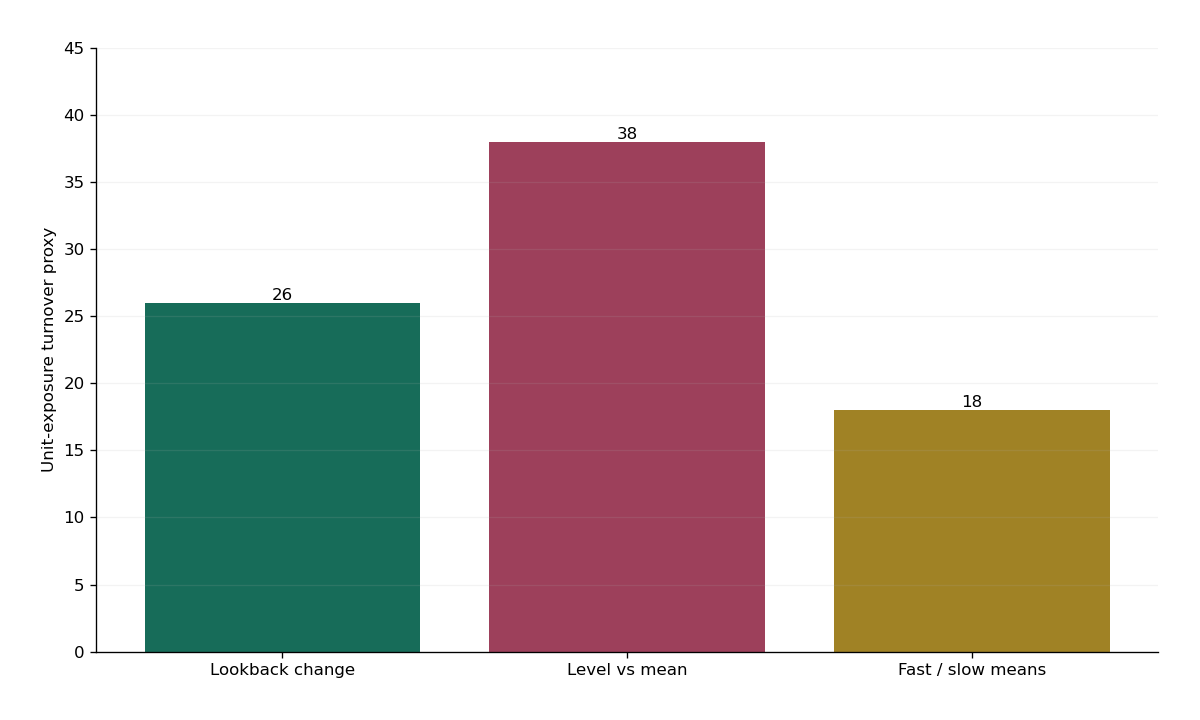
The calculation begins flat and ends flat. A transition from zero to +1 consumes one unit of turnover, a transition from +1 to -1 consumes two, and closing a final nonzero state consumes one. Under that convention, lookback change has 26 units, level versus mean has 38, and fast/slow means has 18. Direct sign reversals number eleven, eighteen and eight respectively. The lookback rule also visits neutrality, which is why a reversal count alone does not fully describe its transitions.
Multiplying those turnover totals by the selected three-basis-point one-way assumption gives 78, 114 and 54 basis points. These are linear cost proxies on one fixed unit of reference exposure. They are not costs as a percentage of investor capital. The arithmetic contains neither changing contract size nor volatility-target adjustments. It also excludes the transactions needed to maintain actual futures exposure across expiries. A lower number in this table describes less state-transition turnover under this protocol; it does not establish a superior investment.
Contract joins remain a limitation
The front-contract reference changes its underlying contract as maturities advance. This extraction does not supply a complete per-observation delivery-month map or a tradable roll ledger. The methods can therefore respond to changes associated with the reference's construction as well as changes within a particular contract. A two-observation lag does not remove that identity problem. Nor does it prove that an observation was published before a hypothetical order could have been submitted.
The study intentionally stops before a profit calculation. To extend it into an execution study, an analyst would need appropriate contract history, a predetermined roll schedule, quote-unit and multiplier records, available-at timestamps, position sizing, collateral assumptions and realistic trading costs. Those are additional evidence requirements, not hidden defaults supplied by this publication. A continuous reference can support this narrower diagnostic while remaining inadequate for a claim about actual contract returns.
Reproduction, rights and the boundary of the result
The research pack publishes the derived counts, parameters, source provenance and exact method protocol. Raw historical price observations are not redistributed in the public bundle. Readers can obtain the original history from the linked EIA source and compare their extraction with the recorded window and hashes. EIA's general reuse statement includes qualifications for third-party material; it should not be treated as blanket permission for every underlying data product.
A reproduction should first match the dates and source vintage, then check information-row selection, means, state signs, initial entry and terminal flattening. Only after those checks should it compare the final table. Different results may reveal a revised download, a different contract series, a calendar convention or a genuine calculation error. The useful outcome is a traceable explanation, not a forced match obtained by changing settings. This release qualifies the data for the stated reference-level comparison only; it does not qualify a live model, a managed account or a trading programme.
Research checkpoints
- The frozen study assesses 250 observations after retaining 127 prior rows.
- All-rule agreement is 176/250; it measures agreement, not predictive accuracy.
- Turnover includes the initial entry and terminal flattening but not actual contract rolls.
- No trading-return or model-certification claim follows from these diagnostics.
Source record
Related methods
Continuous Futures Series: A Construction, Not a Contract
Learn how contract selection, switching and blending shape a continuous reference series and limit what it can establish.
Signal Timing and Lookahead: Follow the Information Clock
Trace observation, publication, calculation and delayed use, with practical examples of leakage and missing-data traps.
Turnover and One-Way Costs: Count Every Change Once
Define a directional turnover proxy, handle reversals and roll legs, and translate explicit one-way cost assumptions into a budget.
Reproducible Method Comparisons Without Performance Claims
Freeze inputs, timing and tie rules to compare three deterministic directional methods with a two-observation lag and a turnover proxy.
Published 16 October 2026. Illustrations and reference diagnostics do not establish strategy profitability or execution quality.